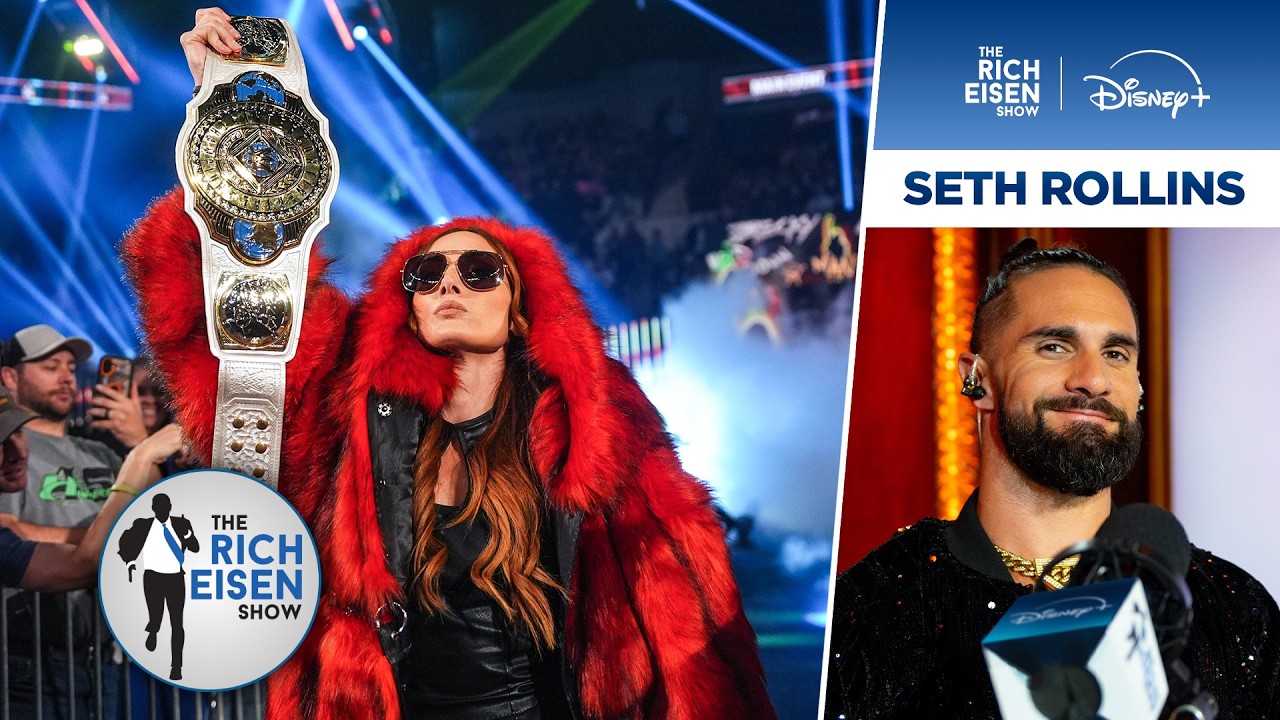
Exclusive 100th Episode interview with "The Man" Becky Lynch | No-Contest Wrestling
No Contest Wrestling hit 100 episodes, and TJ and O'Shea Jackson Jr. marked it by landing the first active female WWE superstar to sit in their studio. Becky Lynch showed up with nowhere to be for a few hours, which turned out to be the most important detail of the day.
The intro alone was a scavenger hunt, built entirely out of her old entrance themes, from the MC Hammer days through trouble with a capital T. Then the resume: Royal Rumble winner, Grand Slam champion, three-time Intercontinental Champion, seven-time world champion, the first ever SmackDown Women's Champion, the first woman to hold the Raw and SmackDown titles at the same time, the first woman on the cover of the video game, and the first woman to win a WrestleMania main event.
Asked what it feels like to collect that many firsts, Lynch was almost annoyed by the question, and her reason explains a lot about her.
"You're always just thinking about what's next as opposed to like, oh, I did that once." She called it a terrible way to live, then defended it as an occupational necessity. "You're only as good as your last match or your last story line or your last segment, because everything's constantly moving."
That answer put her in the majority. TJ noted the show has asked many champions about the night they won their first world title, and while Mark Henry gave an emotional answer after waiting 15 years for his, Rey Mysterio and Eric Bischoff both said essentially the same thing. They were already thinking about next week.
Her fandom started the way most do, secondhand. Wrestling was always on, and she had an older brother, Richie. She remembers loving Hulk Hogan, hiding when the Undertaker came on, and being terrified of Paul Bearer. Mostly she remembers playing it. Wrestling matches on her mother's bed, doing the entrances, wearing her mom's fur waistcoat and using her leather gloves to apply a mandible claw that did not exist yet.
She also dropkicked Richie into a wall hard enough that he ended up wedged between the dresser and the floor, and he never told on her. "What a legend of a life. Shout out to Richie, who's not snitching."
She fell out of it, then mocked her brother for still watching, and then Mick Foley talked her back in. "I was like, oh, they're all fake, it's for babies." Foley's promos changed that. "Just call me when he's on."
She was 12 or 13, and the timing mattered. She was in her goth era, black lipstick and a dog collar, hanging around Dublin's Central Bank where the goths and rockers and hippies congregated and everyone defined themselves by their music. Wrestling slotted into that alternative world, and it gave her something more useful than a hobby.
"It gave me a bit of an identity. You were the girl that liked wrestling and rock music." She compared herself to the girl in the Bowling for Soup song, and was candid that part of the appeal was having something to talk about with older teenage boys she found extremely good-looking.
She also offered the cleanest description of wrestling fandom anyone has given on that show. "If you want to talk about wrestling to someone who loves wrestling, there's no explanation needed. But if it's someone who's not into wrestling, there's no explanation you can give them that's going to make it make sense."
She was not an athlete. She rode horses badly and broke her elbow on a pony called Snowy, and admitted she was mostly in it for the chocolate croissants at the equestrian center. She liked basketball but had no hoop, so she and her friends threw at a specific spot on a lamppost, occasionally getting into the Mormon church down the road until a friend ruined it for everyone by urinating in a sink. She tried camogie. She was not good at any of it.
Then the fact that reframes the entire interview.
Becky Lynch failed gym class.
Her explanation was that she was still Daria at that point, arms folded, refusing to participate. But she also told the truth underneath it. "I thought I looked funny when I ran, and I didn't want to look funny." She noted, cheerfully, that she still looks funny when she runs. "But now I look funny when I run and I make money out of it."
The turning point was her mother crying. A parent-teacher meeting with a PE teacher who did not like her sent her mom home in tears, and Lynch's reaction was immediate. "I got to turn my life around. 15 years old, failing PE. I'm up to no good. I'm a delinquent."
Gyms in Ireland at the time were scarce and expensive and felt too conventional for her. She wanted something rough. She looked at kickboxing and found nothing. Then she walked into the computer room and found Richie looking at a UK wrestling website, where two Irish lads were training. One of them was Fergal Devitt, who the wrestling world would come to know as Finn Bálor.
When Devitt and his partner opened a school an hour away in Bray, Lynch informed her brother she was going. He told her she was not, because she had to be 16.
She had her dad drive her down the next morning and arrived before Richie did.
She was 15. She told them she was 17, and her reasoning is airtight. "If I said that I was 16, then they might ask me for ID." Nobody lies about being 17.
What she found was not the training montage she expected. There was no ring, just six blue padded mats on the ground. She had come in expecting Tough Enough, everyone jacked, running hills, working out until they puked. Instead it was ten squats and ten jumping jacks and let's go.
She had also expected, quietly, to finally be naturally good at something. "I was like, oh, this is where I find out that I am a protege." She found out the opposite almost immediately. She tried to attack the mat, banged her head, and everything hurt.
But the bumps got better, and that produced the realization she delivered like breaking news. "Oh wow, if you practice at something, you can improve. It's not just in American movies."
What actually kept her there was not ambition. She had none. In 2002 the women getting hired were models or bodybuilders, and her assessment of herself at the time was blunt. "I was just a regular looking girl who wasn't particularly anything." She was not going to WWE. She just wanted to be good at this, and to have somewhere to be that was not drinking on a Monday night.
Her coaches gave her exactly one accommodation, which was none at all. She remembers crying to Devitt over something she was struggling with, telling him she wanted to be the best, not the best for a girl, and that she wanted to be trained like the guys.
His answer ended the conversation. "That's what I've been trying to do."
Then it fell apart. By 18 and 19 she had moved away, was living in Canada, wrestling in Japan and around America, and had convinced herself she was better than she was. In Japan a promoter decided she resembled Britney Spears and tried to push her as a star, and the weight of it landed on someone who was still, functionally, a kid with no mentor she was willing to let close.
"I self combusted."
She quit for seven years.
Jackson offered his mother's line for exactly this, and it fit so well Lynch repeated it back. You never give a baby steak. You cut it into small pieces, because if it is too much at once, the baby will never trust it again.
The other thing driving her out was a deadline she had invented. She found a diary from age 19 in which she had written that she needed to get a real job, that she was living in a dream world, that she needed to settle down. "By the time I hit 20, the carriage was going to turn back into a pumpkin."
That led to the most interesting tangent of the episode, about how wrestling and sports train people to feel ancient absurdly early. When Lynch went for her WWE tryout at 25, the cutoff for women was 26. Even then she felt she was pushing it. "If I don't get in now, that's it. Dream's dead."
She thinks that has genuinely changed, and she is glad. She recalled hearing someone say "I'm only 27" and having to sit with how foreign that sounded, because at 27 she had budgeted maybe two more years in WWE before marriage and a kid.
During the seven years she got a degree in acting, did a personal training diploma in Orlando, and became a flight attendant for Aer Lingus for two and a half years, following her mother, who did it for 29 years and loved it. Lynch did not. Her uniform never fit right, she never felt she belonged, and she developed a fear of flying she did not have before training taught her everything that can go wrong. She asked during that training what happens if you simply freeze, and was told not to think about that. "Okay, great. Practical skills. Great. I love it."
She also confirmed, for anyone wondering about airline water, that when the bottles ran out they filled them from the galley tap. Her medical opinion on the practice: "I would drink it. No bother. There's nothing wrong with me."
The way back in was almost accidental. A friend at her gym and that friend's boyfriend, Joe, had both been signed by WWE. Lynch had a role coming as a stunt woman on Vikings and no idea what she was doing, so she went to Joe's wrestling school to get back into shape. He told her she still had it, and then, after a conversation about promos, asked whether she would consider a tryout.
She had her flights to New York booked. She was going to do theater.
"It was just that, like, can I allow myself to go back into this thing that I love?"
Joe called Robbie Brookside, who was then helping with recruiting, and the call landed on a coincidence. Brookside had worked a show with Lynch when she was 19, in which she and Paige's mother beat each other senseless in a match Brookside remembered specifically because of how well she matched a famously stiff opponent. Then she vanished from the business.
"Oh, Knoxy girl. I was wondering what happened to you."
Sheamus gave her advice too, and Lynch got emotional talking about him generally, calling him like a brother and saying she does not know where she would be without him. During her hardest stretch in NXT he took her to Halloween Horror Nights and handed her Father Ted and IT Crowd DVDs.
Her account of NXT was unsentimental. "Difficult, very hard, very trying." She thinks the system is designed to break people down and force them to either solve something or fight back, and she is not sure whether that is intentional or a very useful accident.
The trap inside it is comparison, watching people get called up ahead of you. Her way out was a decision she still repeats. "It's not my journey. The more I keep comparing myself, the more I'm pushing myself to be less special."
She had good company in the breakdown. Promo class, she said, was essentially a variety show, a place to try characters that were never going to make television, with Dusty Rhodes sitting there telling stories about ghosts and trains. Some people arrived fully formed. Others were figuring it out. She was firmly in the second group, and she was made to relive it when the hosts produced footage of an early rhyming promo she cut alongside Alexa Bliss. She refused to watch it.
On the Four Horsewomen, her read is that the reason it worked was that none of them copied each other. Charlotte Flair went one direction, Bayley another, Sasha Banks another, and Lynch compared the whole arrangement to the Spice Girls, four distinct things appealing to four different audiences while all four privately wanted the best match on the card.
She also participated enthusiastically in the show's long-running joke that Bayley is secretly a menace, giving deliberately deadpan testimony about how she holds the young talent down and deliberately gives them bad advice, which is funny precisely because the opposite is true.
She had no idea who invented her best nickname. The Last Kicker simply arrived on a T-shirt, and her first reaction was a marketing note rather than gratitude. "I don't know that men are going to want to wear that t-shirt." She was not the only one who said so, and it got adjusted. She still does not know who wrote it.
The rapid-fire round produced the best material. Deserted island alone or with the person who annoys you most: alone, instantly. Regret or doubt: doubt, because "you can overcome doubt. Regret, there's no taking back." One person to switch places with for a day: her husband, and she explained why at length, describing a man who is level, patient, never reactive, and capable of seeing all sides before deciding. Her actual curiosity was more pointed. She wants to know how he sees her.
Best compliment ever received: that she is a good mom.
Asked what never fails to make her laugh, she named two scenes with real specificity. Ian McKellen explaining acting to Ricky Gervais on Extras, and Leonardo DiCaprio's breakdown in the trailer in Once Upon a Time in Hollywood, which she quoted at length and clearly loves. "I feel like that sometimes."
For the bar fight crew, five women from any era to get her out of a hostile room, she took Bianca Belair as her right hand without hesitating, then Lita, then Natalya, who she has now known longer than she has not known. For the fifth she went to the future and picked Lyra Valkyria, who she insulted continuously while picking her.
The Belair choice is funnier with history attached, because TJ dug up a call Lynch made to The Rich Eisen Show years ago during their feud, when she had gone after Belair's braid. Lynch relitigated the entire thing on the spot and her defense is airtight in the way only wrestling logic can be. The braid was an illegal weapon. It had already been used to set up a WrestleMania finish. She was simply trying to preserve her own win.
"I had great logic."
Nobody disputed it. Everyone noted how it ended, which is that Lynch got a mullet.
For her Hall of Fame highlight reel, she picked her WrestleMania 38 match with Belair, her Hell in a Cell match with Banks, which she had rewatched the night before, and the mixed tag with Seth Rollins against CM Punk and AJ Lee. On that last one she confirmed a detail Rollins had already made public, which is that she was terrified descending from the rafters while he cheerfully asked whether it was really so bad.
The episode closed with a story Jackson has apparently told on 25 previous episodes and will tell on 25 more. At Fanatics Fest, after meeting Triple H and Stephanie McMahon, he finally got to the Undertaker, the wrestler who started it for him. Everything went well. Then TJ walked up and greeted the Undertaker as Mark.
Jackson's reaction was instantaneous horror. The Undertaker's was more forgiving than it once would have been. "Honestly, I'm a little looser about that nowadays than I would have been back in the day."
Which Jackson found the most disappointing part of all. "I wish I could have just seen a little bit of back in the day."
Watch the full interview with Becky Lynch, O'Shea Jackson Jr. on The Rich Eisen Show, streaming live on Disney+ weekdays Noon-3PM ET.
Adapted from the original segment on The Rich Eisen Show. How we cover the show.