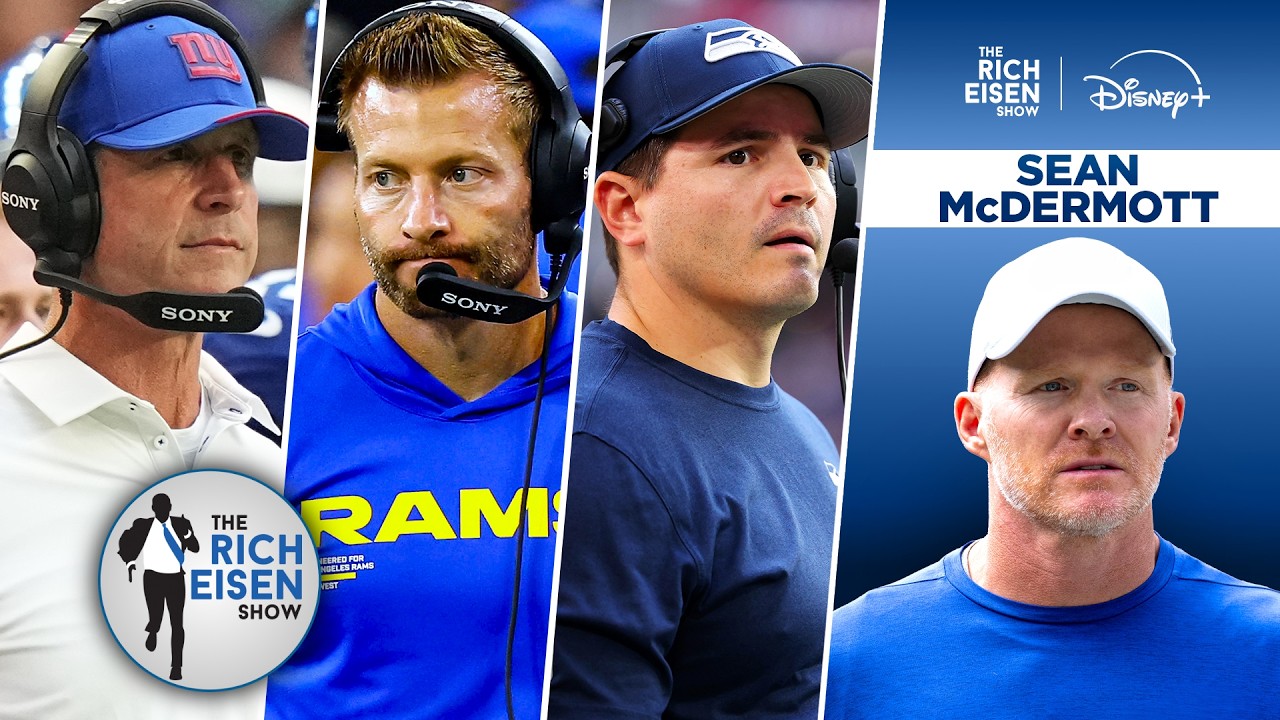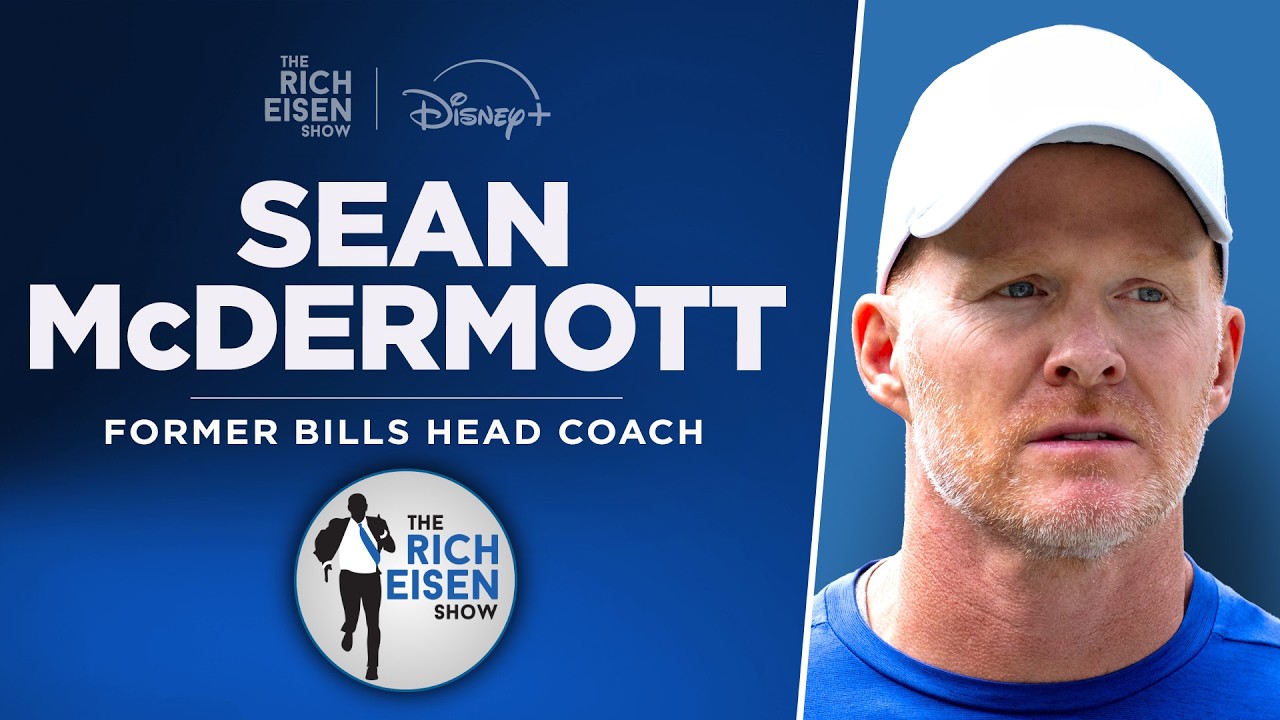
Former HC Sean McDermott Talks Lessons Learned, McVay & More I Full Interview I The Rich Eisen Show
Most head coaches spend their year away from the sideline telling anyone who will listen why the last job was not their fault. Sean McDermott spent his going around asking people what he got wrong, and then flying to four training camps to watch other men do it better.
"When you're a head coach or a leader of any sort, you don't always get the space to just live life and to reflect," McDermott told Rich. So he took the space. The first part of it was aimed squarely at Buffalo and the nearly ten years he spent there, the good and, more usefully, "the things I'd like to do differently in the next go around."
Then he did the part most people skip. He went back to people still inside the building in Buffalo, people he respects, and ran what he called a blind spot exercise. The logic was simple and a little brutal. As a head coach, "not everything gets to the top of the food chain, right? Every story, every truth." So he went and probed for it. "I want to know what I don't know."
Rich asked the obvious follow-up: what was the toughest truth that came back?
McDermott admitted he had gone in hunting for negatives and was caught off guard by how much of the feedback was affection. "I was blown away by a ton of love." But one answer landed differently. "The hardest truth I got was, and it hit me between the eyes, Rich, was sharing more of myself. Sharing more of who Sean really is." He was clear that this was not a coaching failure but a personal one, about "dropping my guard a little bit and really just showing them my true self as a person." He thinks it is an occupational hazard. Leaders get so locked into the job and the task that the person disappears behind it.
None of this is a farewell tour. "I want to coach again. I want to be a head coach in the NFL, and I've got this burning desire in my heart to win a world championship." He framed it as an obligation in two directions, to himself and to whichever organization hires him next, because he wants to build on Buffalo rather than start over from it.
Which brings us to the summer itinerary. McDermott hit one spring practice and three training camps, and the list is not a random sampling. It is a curriculum.
He started with John Harbaugh and the Giants, the one name already inside his circle. The two worked together for about eight years in Philadelphia under Andy Reid, and McDermott sees their careers running parallel, both leaving a place where they had spent fifteen years or close to it and won at a high level. The difference is what they did next. Harbaugh got right back in. McDermott stayed out to reflect. So he wanted to sit "hip to hip" with Harbaugh in the spring and watch a rebuild in its opening stage, the systems going in, the departments getting restructured. They sat for the better part of two days trading best practices.
Rich pushed him on the detail everyone in New York is talking about, the volume of padded practices. Why would a new coach walk in and immediately make it harder?
McDermott's answer was that this is what a second go-around looks like. "You go with what you know. You go with what you believe in." A coach on his second stop is not auditioning for affection. "He's not going to try and do things to make sure that people like him," McDermott said, and the likeability arrives later, attached to winning. Harbaugh has spent fifteen years vetting these systems and has a ring to show for them.
The piece McDermott kept coming back to was not the pads. It was the explanation attached to them. Harbaugh, he said, is a great communicator, and that is what makes the workload survivable. "They want to know the why. Once we know the why, we may disagree, but at least we know and understand why we're doing something. So they can attack at full speed with that in mind." A coach who pads them up without the why gets a locker room asking what gives.
From there he flew to Los Angeles to watch Sean McVay, and he did something more rigorous than hanging around the practice field. He interviewed everybody. "I asked every player that I came across or every staff member, whether it was a coach, equipment manager, trainer, personnel department, I said, what makes Sean special?" The answer never varied. "And to a person, they said his authenticity."
It struck him hard enough that he changed his vantage point. "At one point I even walked on the other side of the practice field just so I could kind of get alone and just watch Sean move and how he was connecting."
Ben Johnson and Mike Macdonald were different, and McDermott said so plainly. Neither was inside his coaching circle, which is exactly what impressed him about the access. "What a fraternity coaching is, to where these guys were willing to open their doors to me and share their wisdom."
With Johnson, whom he met in Nashville around the Bears and Titans joint practices, the agenda was specific and a little self-interested. Beyond dinner they sat for roughly three hours, and while some of it was about the head coaching job, McDermott wanted offense. "I'm going to be hiring, hopefully, an offensive coordinator someday here in the future and I want to know more than I knew before about it." His read on Johnson is not subtle. "He's quite honestly a mastermind of offensive football," and one of the best play callers in the sport.
What actually transferred, though, was temperament. McDermott tied what Johnson said to what he saw on film and in that Tennessee practice, and the word he landed on was intensity. "There's certainly creativity, but there's this intensity of expectation, and it's getting in and out of a huddle and doing the little things right." That he can relate to. A standard of excellence in anything and everything, met daily. "They're a reflection of their head coach."
Rich wanted confirmation that the intensity is real and not a broadcast creation. McDermott confirmed it, then went somewhere more interesting, pointing at Johnson tearing his shirt off as an act of vulnerability rather than theater, with the practical caveat that you had better have done a couple of push-ups first.
Macdonald produced the sharpest insight of the hour. Rich asked about the scheme, and McDermott started with the person instead, because he had seen the same thing on Hard Knocks that everyone else has. "You're seeing Mike be vulnerable with his team in those team meetings, on the practice field," and it carried into their private conversation too. "That's a superpower in and of itself. Being vulnerable, or not afraid to be vulnerable, with your team. The NFL is an alpha league, and yet at the same time we're all humans."
On the defense, McDermott got Macdonald to explain why his system does not trace neatly to any one mentor. McDermott had assumed a particular coaching lineage and was told flatly that it did not exist. Then came the smile and the real answer. "When you're coaching college, people in the NFL talk," whereas NFL coaches guard everything from each other because they play each other. So during the Michigan years, Macdonald could call defensive coaches around the league and they would actually tell him things. The system that came out of it is genuinely his, with recognizable carryover lurking underneath.
But the thing McDermott actually went to Seattle for was not scheme at all. It was the arc. "What his evolution has been from year one, kind of where they were hitting some turbulence, to year two and winning a Super Bowl. And that's really what I'm after as a head coach. I've done just about everything else, but I'm after a world championship."
Rich closed with two sports radio questions. First, the Rams, and whether a roster stacked with Aaron Donald, Myles Garrett, Matthew Stafford, Puka Nacua and Davante Adams can possibly lose. McDermott called it "to some extent an embarrassment of riches" and credited Les Snead for the construction, then argued the underrated part is the locker room. Veterans who have been there and done that produce "built-in player-driven leadership," and that is what actually converts talent into results.
He was not conceding the trophy, though. "I think Buffalo. I really do." When he left, "we were this far away from getting to a Super Bowl and winning one," and he likes what Brandon Beane has done since. "If you're betting on a Super Bowl contender, they're certainly one of them." Pressed for a pick, he gave one. "That'd be Bills-Rams. That'd be a great Super Bowl."
He is not pretending to be neutral about it either. "People ask me all the time, do you still root for your old team? And I said, why wouldn't I?" Then the coda that made the answer worth asking for. "The wins and the losses are important, but it's the impact you leave, or that is left on people and the fan base, and them on you. That's the real part of sports."
The last question was about Joe Brady, and McDermott's answer reframed the job entirely. Every coach in the league carries pressure, but the shape of it varies enormously by inheritance. "There's not many that come into a job basically standing at the doorstep and knocking on the door of the Super Bowl. When I came into a job, there was a 17-year playoff drought. Most coaches come into a job where the organization is sick or unhealthy in some way." Brady is walking into the opposite problem, and McDermott thinks he is well positioned for it, with four years in that building as a real advantage.
The challenge, when Rich pressed for specifics, is the stuff no amount of preparation covers. "You can take notes, but until you're in the shoes on the sideline, every experience is a new experience, because you've never really done it full speed live." Situational football. Decisions. Adjustments. Brady is smart and he works hard, which McDermott called two great qualities, "but until you've done it, you don't have the experience that you get on the job."
Then he had somewhere to be. His sophomore quarterback son plays for Charlotte Christian against Charlotte Catholic that night, and McDermott has a very specific viewing protocol. He climbs as high into the bleachers as he can, usually into a corner, and away from his wife by mutual agreement. "I don't really like to have conversations when they're playing." A college softball coach he knows asked to tag along, and McDermott stalled on the reply, thinking, "You don't know what you're getting yourself into."
Watch the full interview with Sean McDermott on The Rich Eisen Show, streaming live on Disney+ weekdays Noon-3PM ET.
Adapted from the original segment on The Rich Eisen Show. How we cover the show.