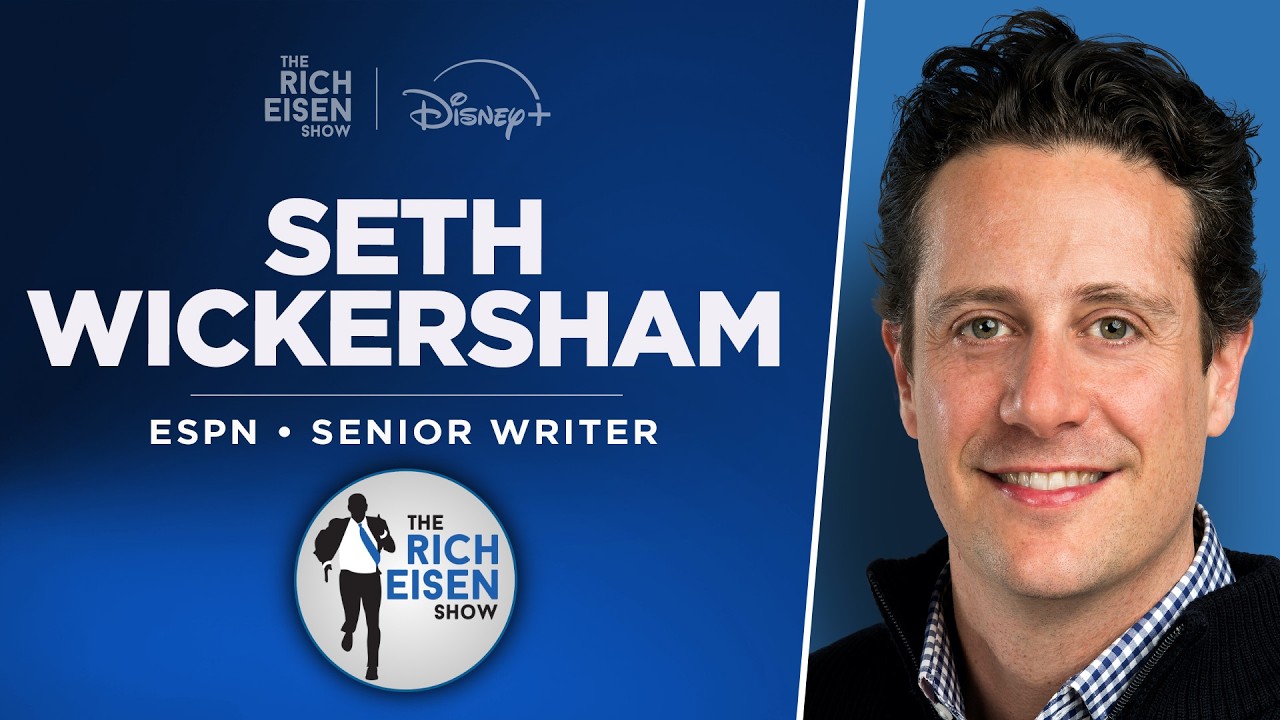
ESPN's Seth Wickersham Talks His New Book, Brady, Mahomes & More I Full Interview I Rich Eisen Show
Seth Wickersham has a new book, and he opened by suggesting a better title for it.
Beyond That Hill collects his ESPN work, which he acknowledged is a particular kind of publishing move. "I probably should have named it Cashing In Twice."
The actual ambition is larger than a greatest hits. Wickersham said the goal was not simply to hand readers his best stories, but to assemble something that reflects how sports, and maybe the country, has changed over 20 years. "So that the book has a point."
His own path to writing any of it is a story he clearly enjoys telling. Wickersham was hired at ESPN The Magazine out of college in 2000, and it remains his only employer.
As a senior at Missouri he had no idea how he was going to get a job. He and his classmates covered Rams and Chiefs games for a tiny school paper purely so they could say they had covered an NFL game. That was the year the Rams reached the Super Bowl with the Kurt Warner turnaround team, and Wright Thompson, now a colleague and one of his oldest friends, had the idea to apply for Super Bowl credentials as college students.
They got them. They took a week off and went to Atlanta, which spent the entire week under an ice storm.
In the media center Wickersham ran into John Papanek, then the magazine's editor-in-chief. He had noticed the magazine was letting a lot of young writers write, and decided he wanted to be one of them, so he pitched himself on the spot. He was careful not to oversell the causation. It was not a straight line from that conversation to a job.
Two weeks after graduation, that is where he was. Thompson, appropriately, wrote the book's foreword.
Asked which piece he is proudest of, Wickersham did not hesitate. It is the 2017 story he and Don Van Natta did about Roger Goodell and Jerry Jones, and the backstory is better than most of what makes print.
The setting was a genuinely difficult fall for the league, with the anthem protests dominating coverage and Wickersham and Van Natta having already broken one of the season's defining quotes. In the middle of that, Jones was threatening to sue the NFL to block Goodell's contract extension. Wickersham described it as "a cold war between two of the most powerful people in sports," and the two reporters believed they could tell it from the inside.
Then, with the story about to go to print, Wickersham got a call while driving from New York to Connecticut. Van Natta had just come off the phone with an impeccable source, who described a call earlier that year between Goodell, Jones and league general counsel Jeff Pash, in which Jones was informed that Ezekiel Elliott was suspended.
Jones was surprised, which Wickersham put mildly, and then angry.
The source went exactly as far as sources go. "We're not at liberty to say what happened, but there was some colorful language, and you guys should try to figure out what was said."
So they worked the phones until they had it. Jones told Goodell that he thought Robert Kraft had come after him hard, and that Kraft was nothing compared to what Jones intended to do to him.
Wickersham framed why that kind of reporting matters in a sentence that could serve as the book's thesis. "People love football most and know about it the least."
Rich then asked the question the book invites, given that Mahomes, Brady, Deion Sanders and Kobe Bryant are all in it. Who is the fiercest competitor he has encountered?
Wickersham went to Brady, and answered it with a scene from before anyone knew.
It was October of 2001. Wickersham had been hired the previous year and was getting his first shot at big features. ESPN sent him to Foxboro to write about a young quarterback playing well in relief of Drew Bledsoe, a kid who would presumably return to the bench shortly.
"He's wearing like a gray sweatsuit and a backpack. He looks like a junior at Michigan."
And then Brady said the thing Wickersham has been turning over ever since. "Football's always come really easy to me."
At the time, two young men getting their break simultaneously, Wickersham had no perspective on it. He does now. "Anytime he says something like that, he means it to the bottom of his soul."
He was careful to distinguish that from the more familiar version of drive. Bryant, he noted, carried the spotlight from the moment he was drafted and had something to live up to. Brady was under the radar, split time with Drew Henson at Michigan, and arrived after Brian Griese had won a national championship.
Wickersham's read is that Brady's greatness came from an innate feel rather than a grievance, and that the clues are scattered through decades of small remarks. "It doesn't mean that he never had to work at it, because he obviously worked his tail off. But those are the things where he had an innate sense of the game."
The best of those clues came about a decade later, in Brady's living room, when he told Wickersham that his first ten years in the league had prepared him for his last ten.
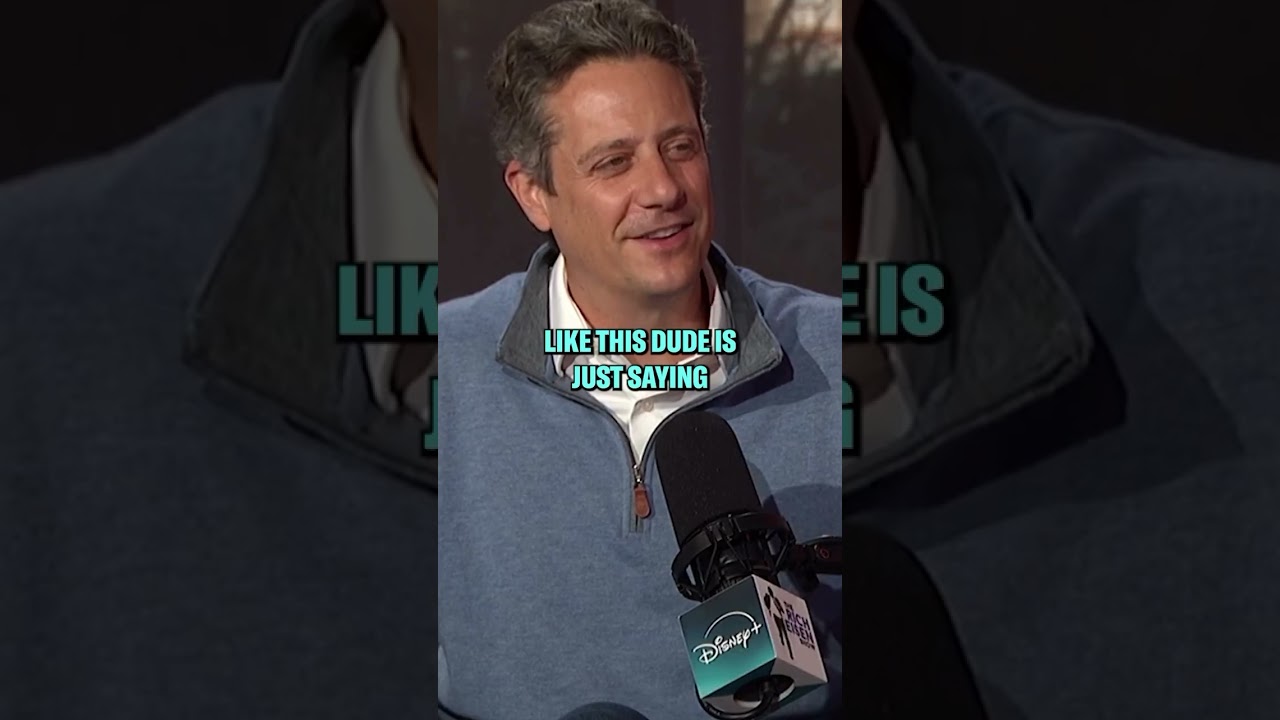
"And I was like, what? This dude is just saying he's going to play 20 years?"
Wickersham took him at his word and did not believe he would do it. "I think he did okay on that."
The book also contains the institutional counterweight to all of that. In Brady's mid-30s, Bill Belichick presented Robert Kraft with a study showing how quarterbacks tail off after that age, and used it as the justification for drafting Jimmy Garoppolo and beginning a transition plan.
Brady outlasted Garoppolo, and then he outlasted the argument. Wickersham's story about the last days of the Patriot Way contains a line Kraft delivered to a confidant after Belichick opened the door and Brady walked out of it, went to Tampa and won a title.
"Bill told me he couldn't play anymore, and then he goes out and wins an effing Super Bowl."
Rich raised the fair counterpoint, which is that the 2019 Patriots roster was not built to win a championship regardless, and both men agreed. But Wickersham's summary of what makes Brady genuinely unusual had nothing to do with the roster. "Unlike almost any unique athlete, his body outlasted his will for football, which is almost every time the other way around."
On Mahomes, Wickersham first noted the detail from his long profile that escaped containment. Three sentences about Mahomes putting ketchup on steak turned into the story's most discussed feature, to the point that it was still being talked about on Good Morning Football weeks later.
What actually interests him is how differently Mahomes is wired from Brady. Both share the drive, which Wickersham described in terms that apply to almost nobody else. "They're running for a finish line that doesn't really exist. They're competing only against themselves."
The divergence is in the fuel. Mahomes was under the radar in Texas, which sounds absurd now and is nonetheless true. He did not qualify for the Elite 11 regional, the step before the national showcase. Wickersham asked him about it expecting the standard answer, the chip on the shoulder that Brady has built a public identity around, with UCLA pulling a scholarship and the sixth round and all the rest.
Mahomes gave him nothing. "No, East Texas isn't really known for quarterbacks, and I was more known for baseball, and that was that."
Wickersham found that genuinely revealing, because the book is fundamentally about where greatness comes from and what it costs. The dominant American model, the one he traced to Michael Jordan, involves finding slights, nurturing them and occasionally inventing them. "That was never the case with him. He's someone who's always been running his own race."
Rich pushed on whether Mahomes really ignores it, given that he was not first on a recent ranking built from anonymous league voices. Wickersham allowed that Mahomes surely notices, and offered a subtler theory. Even Brady kept that material publicly at bay while playing and only became transparent about collecting it later. Maybe Mahomes does the same. "Maybe he'll look back on it and he'll say, yeah, I was looking at all these people talking about how I wasn't the top one on the list."
Sean McVay is also in the book, and Wickersham's reporting on him is the most personal material in the interview. He spent an entire offseason with McVay immediately after the Super Bowl, during the stretch when McVay was seriously weighing a move into broadcasting because the stress had gotten to him.
What Wickersham is watching for now is the second version of that. The Rams are everyone's super team, and nobody cruises through an NFL season. "They're going to hit a rough patch at some point." How the group handles that under those expectations, and how McVay handles it personally, are two different questions.
He was direct about the second one. "He is as ambitious as they come. He can go to some dark, dark places."
Asked what that actually means, Wickersham described a condition rather than an episode. "There's people who just aren't at peace personally until they feel like the game plan is at peace." And the trouble is that the target is not a play. "It's a feeling that they're going for, and how they arrive there over the course of a Monday, Tuesday, Wednesday, Thursday, Friday can be really straining."
His view is that McVay has since built a healthier personal life around the job, and that the template has served him as a coach and as a person. He is now married with two children, which was not the case the last time the franchise loaded up.
That description prompted a good final question from Rich. Is that pressure, the Monday-through-Friday grind of a game plan that never feels finished, why Sean Payton stepped away from calling plays?
Wickersham thinks it is part of it, and he had Payton's own metaphor for it. "Sometimes as you get older, you don't like driving at night in the rain."
He does not read it as permanent, and suspects Payton takes play calling back from Davis Webb eventually. For now it frees him for situational football, the area Brady is so good at illuminating on broadcasts, and the thing the Patriots built an era on.
Beyond That Hill is out Tuesday, September 22nd.
Watch the full interview with Seth Wickersham on The Rich Eisen Show, streaming live on Disney+ weekdays Noon-3PM ET.
Adapted from the original segment on The Rich Eisen Show. How we cover the show.