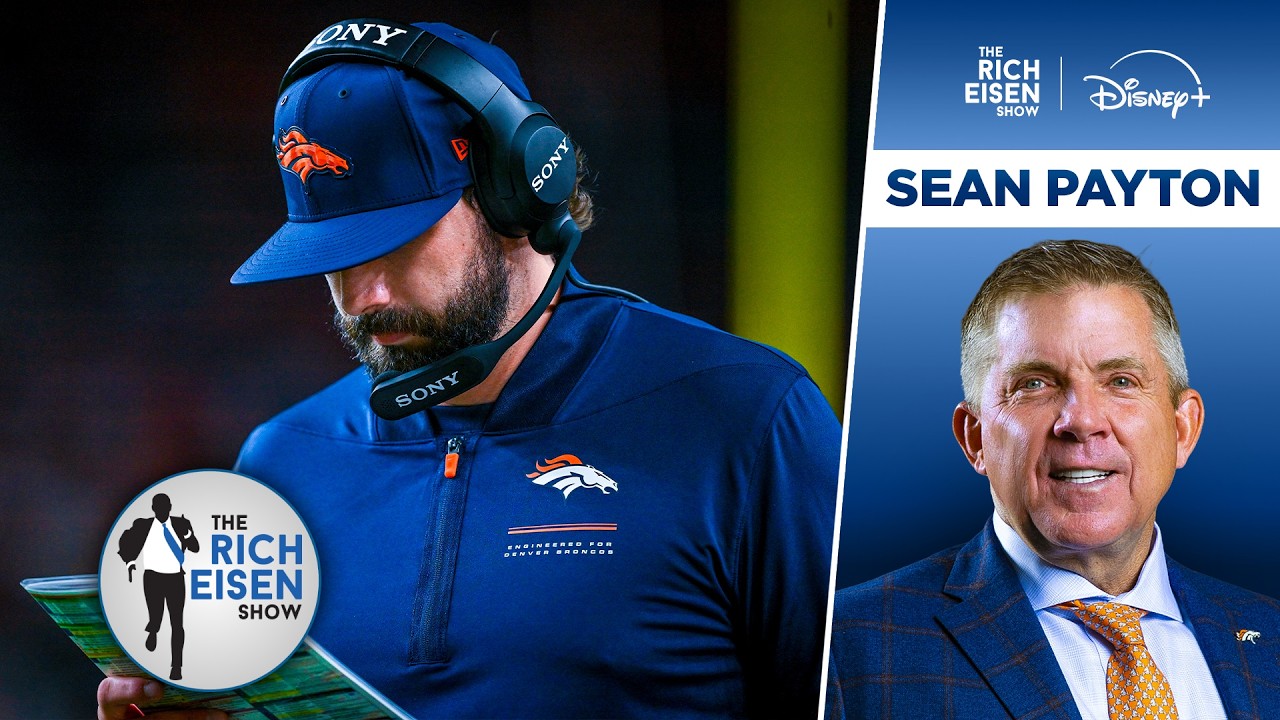
Broncos HC Sean Payton Weighs In on That Rams Controversial P.I. Flag
Sean Payton is a friend Rich has known for decades, and the Denver Broncos head coach joined the show fresh off a Sunday night win over the Rams. He arrived deep in game-planning mode, happy to be back on a normal rhythm after a season that opened on a Monday night with a short week. Rich had three things he wanted to get into: the slow offensive starts, the pass interference flag everyone was talking about, and what it is like to be a play-caller who is no longer calling the plays.
Rich opened with the storyline that has followed Denver's offense. The Broncos keep starting games slowly, though, as Rich pointed out, the same thing happened last year and they nearly made the Super Bowl.
Payton, who said he had been asked about it postgame, was candid that it cuts both ways. "There's an element as the head coach you love seeing the grit or the resilience of a team that can fight back," he said, "and then you also recognize that we're going to play in games where we're going to have to be able to start quicker in the first half." Getting ahead was one of the keys against the Rams, because against a really good offense it would be hard to play from behind.
He called it "an ongoing, I'd say, work in progress." He likes that his team can play well late, because close games come down to the final drive and making the plays that matter. But he also knows what is coming on the schedule. "We're going to play good opponents as we move forward where if we dig ourselves in a hole, it's going to be more challenging."
That was his message to the team in Monday's meeting. "Man, I love the fact that you guys feel like you're in every game, but we do have to figure out a way to be more efficient in four quarters."
Payton returned to the theme at the end of the interview, and he was even more direct. "We can't be seventh or eighth out of the gate all the time with these starts," he said. "Eventually there's going to be a time where someone stays out of reach, and I think that we have to work on that."
Then Rich got to the fun one, the Rams pass interference flag. For at least 24 hours, people were talking about a pass interference call that went Denver's way against the Rams in the fourth quarter of a crucial game. "Is that a new feeling for you?" Rich asked.
Payton pointed out there were actually two calls on that final drive, one on Denver's sideline and one that was not, and that from the sideline you do not have a great vantage point. He did not really see them until he watched the tape. As a young coach, he said, he would live with calls like that and be on the phone about them the next day. Over time, you "become wiser where you burn your calories." He offered an example from two weeks ago, a third down play to Waddle in the first half that "could easily been an interference or holding call." You just go. "You can't really control it. You hope by the end of the season more fall in your favor."
What he can control is technique. The Broncos spend a lot of time on pre-snap versus post-snap fouls, and Payton admitted to a recent pre-snap penalty for aligning too deep on a running play.
Rich would not let him off that easily. Did any part of him think, cosmically, karmically, that he was owed that flag? Payton laughed it off. "That seemed like an eternity ago," he said. "So, thanks for having me on your show to remind me."
He did acknowledge "the irony here." A lot was drawn to that earlier playoff play because of the finality of where it came in the game and because it involved a trip to the Super Bowl, but he said the comparison did not even hit him until he read some of the comments. He also stressed that the officials are trying to get it right in a game that moves fast.
Rich's last question was about life as a play-caller who no longer calls the plays. He noted that Davis Webb was "in his bag" in the second half and asked Payton to let him inside his inner monologue while somebody else calls the plays.
Payton explained he is still part of the offensive process and still in the meetings. During a series, the play-caller is racing to the next play, so the head coach waits for natural breaks. "When the series is over, here are the next two or three runs. Here's a thought relative to play action or drop back." Situational reminders matter most. In a 16-0 game in the third quarter, he told Webb to be ready for a two-point play, something he normally would not look at until the fourth quarter, because points were at a premium. He might also say think four-down territory, which changes a third and six at the 40 completely.
"You're trying to help in a productive way without creating too much noise," Payton said.
Rich asked whether Payton ever bites his tongue, remembering what it was like when he was the one calling plays for someone else. Payton recalled working for Bill, where "every play was a groan," a stream of adjectives and comments that became "almost white noise" you could not let affect you. Payton said he is probably not the same that way. Sometimes he expects to dislike a call and it turns into a good play.
The goal is to have most decisions made well before kickoff, especially third down, red zone and short yardage. In the normal flow, the best discussion happens between series or during a TV break with the quarterback in the triangle, like a moment against Jacksonville when Bo Nix had a thought and the collaboration paid off. Payton said Webb has done a good job of balancing that and creating a flow.
Next up for Denver is San Francisco. If the Broncos can find the first-half version of what they have been doing after halftime, Payton may not need many more comeback stories.
Watch the full interview with Sean Payton on The Rich Eisen Show, streaming live on Disney+ weekdays Noon-3PM ET.
Adapted from the original segment on The Rich Eisen Show. How we cover the show.